Introduction
This guide explains how one can determine the most appropriate cutting width for a robot mower when managing a small yard. It outlines the importance of matching mower width to yard dimensions, explains how cutting width influences efficiency, and demonstrates how to integrate complementary tools. By following the steps, a homeowner will reduce mowing time, conserve battery life, and achieve a consistently manicured lawn.
Choosing the correct cutting width is especially critical for yards under 1,600 square feet, where excessive width can cause navigation challenges and insufficient width can increase mowing cycles. The information presented is based on product specifications, customer feedback, and best practices for lawn care.
What You'll Need
- YARDCARE V100 Robot Lawn Mower – 6.3‑inch cutting width, AI visual navigation, magnetic NO‑GO strip.
- American Lawn Mower 14" Reel Mower – Manual backup mower for precise edge work.
- Worx Cordless Lawn Mower – 14‑inch electric mower for occasional over‑growth.
- RB 40V Mini Cordless Lawn Mower – Compact 9‑inch mower for tight corners.
- Segway Navimow i105N Robot Lawn Mower – Advanced RTK+Vision system for complex layouts.
- Measuring tape, garden marker stakes, and a notebook for recording dimensions.
Step‑by‑Step Instructions
1. Measure the Total Lawn Area
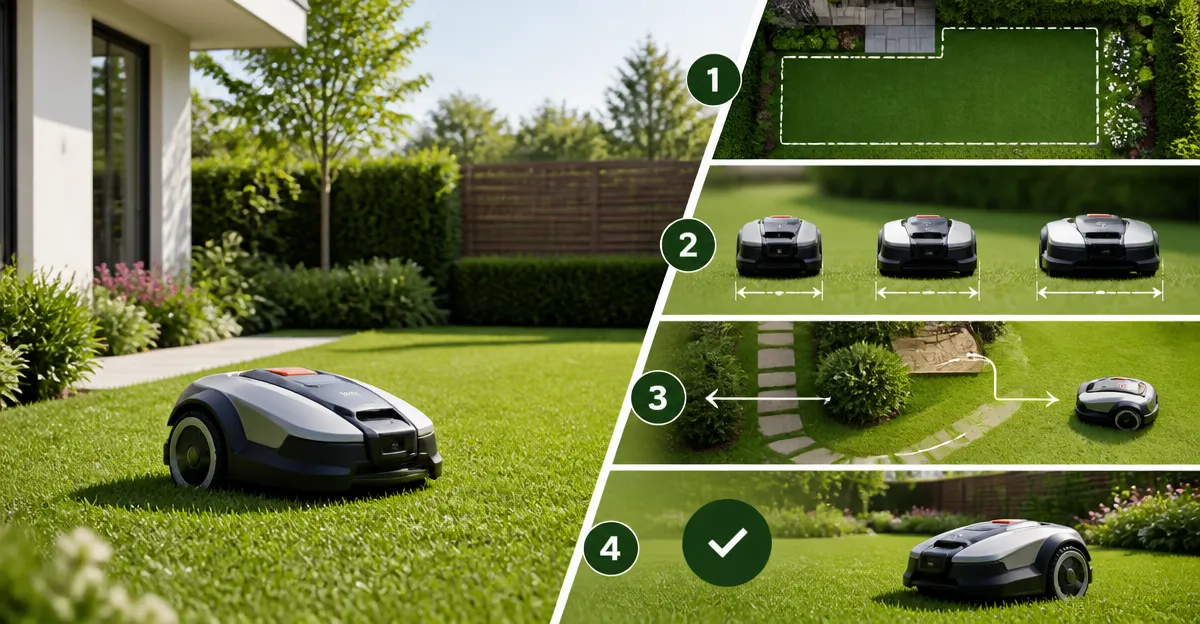
Begin by measuring the length and width of each distinct lawn section using a sturdy measuring tape. Record the dimensions in a notebook and calculate the total square footage by multiplying length by width for each rectangle, then summing the results. For irregular shapes, divide the area into smaller rectangles or triangles, calculate each, and add them together. Accurate measurement is essential because the YARDCARE V100 is rated for up to 1,600 sq ft, while the Segway Navimow i105N can handle up to 1,200 sq m (approximately 1,290 sq ft).
Example: A rectangular yard measuring 40 ft by 30 ft equals 1,200 sq ft, which falls comfortably within the capacity of both robot mowers. If the yard exceeds the stated capacity, consider a larger model or supplement with a manual mower for overflow areas.
2. Identify Obstacles and Define No‑Go Zones
Walk the perimeter and note any flower beds, pools, pathways, or play areas that the mower must avoid. Use garden marker stakes to outline these zones. The YARDCARE V100 includes a 32‑ft magnetic strip that creates temporary NO‑GO boundaries without digging, while the Segway Navimow i105N relies on virtual boundaries set through its app.
Place the magnetic strip along the edges of each obstacle, securing it with the supplied pegs. For the Navimow, launch the app, walk the mower around the desired perimeter, and allow the AI‑assisted mapping feature to record the virtual fence. Both methods ensure the mower respects sensitive areas.
3. Determine Desired Cutting Width Based on Yard Shape
The cutting width of a robot mower directly influences the number of passes required to cover the lawn. A wider cutter reduces pass count but may struggle with narrow passages, while a narrower cutter provides better maneuverability around tight corners. For a small yard with many obstacles, a cutting width of 6‑8 inches is typically optimal.
Compare the specifications: the YARDCARE V100 offers a 6.3‑inch width, suitable for most small yards; the Segway Navimow i105N uses a similar width but adds AI vision for obstacle detection. If the yard contains very narrow alleys, the RB 40V Mini (9‑inch width) or the Worx Cordless (14‑inch width) may be employed manually for those sections.
4. Select the Robot Mower That Matches Width and Capacity
Based on the measured area and desired cutting width, choose a robot mower. The YARDCARE V100 is priced at $399.99, holds a 4.8‑star rating from 58 reviews, and includes a magnetic NO‑GO strip, making it ideal for straightforward yards under 1,600 sq ft.
The Segway Navimow i105N costs $669.00, carries a 4.1‑star rating from 392 reviews, and excels in complex layouts due to its RTK+Vision system. It is best suited for yards with trees, narrow corridors, or uneven terrain where precise mapping is required.
When budget is a primary concern, the YARDCARE V100 provides comparable performance at a lower price point. For users who value advanced mapping and multi‑zone management, the Navimow justifies its higher cost.
5. Prepare the Lawn for Initial Run
Before the first autonomous pass, remove debris, large stones, and any objects that could interfere with the mower’s sensors. Trim tall grass to a maximum of 2.4 inches, which is the upper limit of the YARDCARE V100’s adjustable cutting height. The American Lawn Mower 14" Reel Mower can be used to achieve this initial trim, as it provides a scissor‑like cut without bruising the grass.
Set the cutting height on the robot mower to the middle of its range (approximately 1.5 inches) for the initial run. This setting balances cutting efficiency with battery consumption.
6. Program the Mowing Schedule
Use the manufacturer’s mobile app to set a recurring schedule that matches the growth rate of the grass. For most temperate climates, a three‑times‑per‑week schedule maintains a healthy lawn. The YARDCARE V100 allows scheduling directly from its companion app, while the Segway Navimow i105N offers multi‑zone scheduling and OTA updates.
Enable the rain sensor feature on the YARDCARE V100 to pause mowing during wet conditions, thereby protecting the mower and preventing uneven cuts.
7. Monitor Performance and Adjust Settings
Observe the mower during its first few cycles. Verify that it respects all NO‑GO zones and that the cutting height yields a uniform appearance. If the mower leaves uncut strips, reduce the cutting height slightly or increase the overlap by adjusting the mowing pattern in the app.
For the Navimow, review the map after each cycle and refine virtual boundaries if the mower encounters unexpected obstacles. The AI‑assisted mapping can be updated without restarting the entire mapping process.
8. Use Manual Mowers for Edge Trimming and Overgrowth
Robot mowers often cannot reach the very edge of a fence or the area beneath low shrubs. Employ the American Lawn Mower 14" Reel Mower for precise edge work, as its 14‑inch width and manual control allow close‑in trimming without damaging delicate plants.
When the grass grows beyond the robot’s optimal height (over 2.4 inches), the Worx Cordless Lawn Mower or the RB 40V Mini Cordless Lawn Mower can be used to reduce height before the robot resumes its routine. The Worx model provides a 6‑position height adjustment (1‑3 inches) and a brushless motor for longer runtime, priced at $179.99 with a 4.2‑star rating. The RB Mini offers three height settings (1.2‑2 inches) and weighs only 11.5 lb, making it ideal for tight spaces.
Tips & Pro Tips
- Place the magnetic NO‑GO strip at least 12 inches away from the mower's path to allow the visual sensor to detect the boundary early.
- For the Navimow, ensure a clear line of sight to the sky when installing the GNSS antenna; trees and structures can degrade satellite reception.
- Regularly clean the cutting blades of all mowers to prevent grass buildup, which can reduce cutting efficiency.
- Schedule a battery check every three months; replace the 4 Ah battery on the YARDCARE V100 when capacity drops below 80 percent of its original runtime.
- When using the RB 40V Mini, move at a steady pace similar to a vacuum; excessive speed results in uneven cuts.
Troubleshooting
Problem: Robot mower stops unexpectedly near a boundary.
Solution: Verify that the magnetic strip is firmly seated and that the mower’s visual sensor is not obstructed by debris. Re‑calibrate the NO‑GO zone through the app if necessary.
Problem: Battery drains faster than expected.
Solution: Reduce the cutting height, shorten mowing duration, and ensure the mower is not repeatedly climbing steep slopes (the YARDCARE V100 handles slopes up to 20 degrees).
Problem: Manual mower blades become dull.
Solution: Follow the American Lawn Mower 14" Reel Mower maintenance guide: sharpen the blades every 3‑5 years or after extensive use, using a reel‑sharpening kit.
Conclusion
By measuring the lawn, identifying obstacles, and matching cutting width to yard geometry, one can select a robot mower that maximizes efficiency and minimizes maintenance. The YARDCARE V100 offers an affordable, magnet‑based solution for straightforward yards, while the Segway Navimow i105N provides advanced mapping for complex layouts. Complementary manual mowers ensure that edges and overgrown sections receive proper care. Implementing the steps outlined in this guide will result in a consistently trimmed lawn with reduced labor and lower long‑term costs.
Products Mentioned in This Guide
Frequently Asked Questions
What cutting width is ideal for a yard under 1,600 sq ft?
A 6‑to‑8‑inch width is optimal, offering fast coverage while still navigating tight corners.
How does cutting width impact battery life?
Wider cuts reduce the number of passes needed, which generally extends battery runtime by lowering total travel distance.
Will a wider mower struggle with narrow pathways?
Yes, widths beyond 8 inches can miss narrow aisles or cause navigation errors on small lawns.
Is a manual backup mower necessary for edge trimming?
A small reel mower, like a 14‑inch model, is useful for precise edge work that a robot may skip.
How do I decide between the 6.3‑inch YARDCARE V100 and a larger robot mower?
Choose the V100 if your yard is under 1,600 sq ft and you need tight navigation; larger models suit bigger lawns where speed outweighs maneuverability.