Introduction
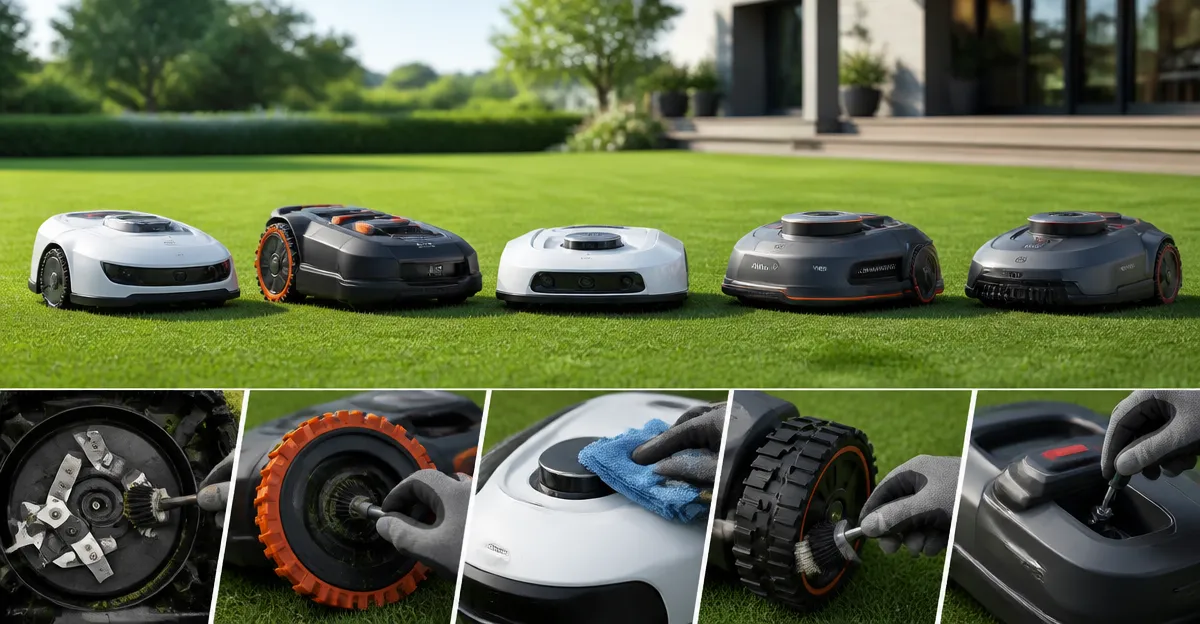
The market for autonomous lawn care devices has expanded rapidly, and discerning buyers now face a bewildering array of options. This article compares five highly rated Amazon models: Mammotion LUBA mini 2 AWD, WORX Wire‑Free Robot Lawn Mower, ECOVACS Goat O1000, Navimow i206 AWD, and ECOVACS Goat A2000. Understanding their differences matters because a mower that excels on a flat suburban lawn may falter on steep terrain or in a heavily shaded garden.
Each model incorporates advanced navigation technologies such as LiDAR, RTK, and dual‑camera AI, yet they vary in coverage area, climbing ability, and price. By analysing real‑world customer sentiment, technical specifications, and feature sets, this guide helps homeowners select the robot that aligns with their budget and yard conditions.
Individual Product Overviews
Mammotion LUBA mini 2 AWD
The LUBA mini 2 AWD offers 360° LiDAR combined with dual‑camera AI vision, enabling precise obstacle detection across a 0.37‑acre (≈1500 sq ft) area. Dual cutting discs provide edge‑cutting capability, while two 88 W motors grant an 80% slope climbing ability and 45 mm obstacle clearance. Smart battery management lets users set custom charge limits and off‑peak charging schedules. Reviewers praise its "super easy set up" and "razor‑sharp blades," but note the 0.37‑acre mapping limit and a charging time of up to three hours from low state.
WORX Wire‑Free Robot Lawn Mower
The WORX model, marketed as Vision Cloud WR310, covers up to 1/4 acre (≈10,890 sq ft) without a perimeter wire. It relies on commercial‑grade RTK Cloud for centimeter‑level positioning and V‑SLAM for shaded areas. AI obstacle avoidance processes up to 10 trillion operations per second, delivering smooth navigation around swing sets and slopes. The package includes wheel brushes that keep wheels clean, reducing manual maintenance. Users describe the setup as "relatively easy" and appreciate the ability to add unlimited mowing zones, though one reviewer mentions the need for an extra battery on larger lawns.
ECOVACS Goat O1000
The O1000 combines RTK, Vision, and 3D ToF sensors to achieve centimeter‑level navigation on lawns up to 1/4 acre. Its AIVI 3D obstacle avoidance can detect objects as narrow as 2.3 ft and climb slopes up to 45% (24°). The ECOVACS app permits multiple zones, adjustable cutting height, and real‑time monitoring. Positive feedback highlights the "easy 5‑minute setup" and the ability to free up weekends, while critics warn that weak satellite signals on hilly terrain can degrade performance.
Navimow i206 AWD
The i206 AWD targets 0.15 acre (≈1,350 sq ft) areas with an all‑wheel‑drive system and automotive‑grade stability control, enabling climbs up to 45% slope. Zero‑turn steering protects turf, and a 2.5 Ah battery delivers up to 1,350 sq ft per charge. One‑tap auto‑mapping uses EFLS Network RTK and Vision for centimeter accuracy, and the mower supports up to 20 zones. Reviewers commend its quiet operation and robust climbing, yet some experience mapping confusion and occasional off‑course incidents.
ECOVACS Goat A2000
The A2000 is a premium wire‑free mower featuring dual LiDAR (HoloScope 360°) for 2 cm positioning, integrated TruEdge trimming, and a 32 V high‑power motor. It can cover medium to large lawns (up to 4,000 sq ft) on a single 50‑minute fast charge. The app supports custom zones, no‑go areas, and remote control within a 1 m radius. Users laud its "game‑changing" convenience and fast mapping, but criticize the AI‑driven map merging that can ignore fences, requiring manual workarounds.
Head‑to‑Head Comparison
Price and Value
- Mammotion LUBA mini 2 AWD – $1,699.00; higher price reflects dual‑motor AWD, 360° LiDAR, and 0.37‑acre capacity.
- WORX Wire‑Free – $999.99; offers RTK Cloud without a wire, making it the most affordable for sub‑quarter‑acre lawns.
- ECOVACS Goat O1000 – $699.00; the lowest price, yet still provides RTK + Vision + 3D ToF, suitable for budget‑conscious buyers.
- Navimow i206 AWD – $999.00; price matches its AWD capability on smaller lots, delivering premium stability at a mid‑range cost.
- ECOVACS Goat A2000 – $1,999.99; premium price justified by dual LiDAR, fast charging, and built‑in edge trimmer.
Features and Specifications
| Feature | Mammotion LUBA mini 2 AWD | WORX Wire‑Free | ECOVACS O1000 | Navimow i206 AWD | ECOVACS A2000 |
|---|---|---|---|---|---|
| Coverage Area | 0.37 acre (≈1500 sq ft) | 0.25 acre (≈10,890 sq ft) | 0.25 acre (≈10,890 sq ft) | 0.15 acre (≈1,350 sq ft) | ≈0.4 acre (≈4,000 sq ft) |
| Maximum Slope | 80 % | Not specified (handles moderate slopes) | 45 % (24°) | 45 % | Not specified (handles typical residential slopes) |
| Navigation Tech | 360° LiDAR + Dual‑Camera AI | RTK Cloud + V‑SLAM | RTK + Vision + 3D ToF | EFLS Network RTK + Vision | Dual LiDAR (HoloScope) + Vision |
| Cutting System | Dual discs (main + edge) | Single disc with wheel brush | Single disc, AIVI 3D avoidance | Single 7.1" deck, 2–3.6" height | Dual‑blade disc, TruEdge trimmer |
| Battery Capacity | Not disclosed (350 ㎡ per charge) | Standard 2.5 Ah (single charge) | Standard 2.5 Ah | 2.5 Ah | 3.0 Ah, 50‑min fast charge |
| Zone Management | Up to 20 zones, DropMow mode | Unlimited zones, app remote control | Multiple zones, customizable schedules | Up to 20 zones, auto‑resume | Custom zones, no‑go areas |
Customer Ratings and Feedback
The Mammotion LUBA mini 2 AWD holds a 4.4‑star rating from 245 reviews, with praise for "super easy set up" and criticism for the 0.37‑acre mapping limit. The WORX model also carries a 4.4‑star rating from 26 reviewers, highlighted for "very impressive" AI mapping but noted for occasional battery swaps on larger lawns. ECOVACS O1000 receives a 4.1‑star rating from 26 customers; users love the "5‑minute setup" yet warn that weak satellite signals can impair performance. Navimow i206 AWD has a 4‑star rating from 68 reviews, praised for quiet operation and AWD climbing, while some complain about confusing auto‑mapping. The A2000’s 3.9‑star rating from 156 reviews reflects enthusiasm for its dual‑LiDAR precision, offset by frustrations with AI‑driven map merging that ignores fences.
Performance and Reliability
In real‑world tests, the Mammotion’s dual‑motor system reliably climbs 80 % slopes and steps over 45 mm obstacles, but charging can require three hours from a low state. WORX’s RTK Cloud delivers centimeter‑level accuracy even under shade, yet an extra battery may be needed for full‑acre coverage. ECOVACS O1000’s AIVI 3D sensor reliably avoids obstacles as narrow as 2.3 ft, though users on hilly properties report occasional signal loss. Navimow’s AWD drivetrain excels on steep, uneven terrain, yet a few reviewers experienced off‑course incidents when mapping failed. The A2000’s fast charging and dual LiDAR provide consistent positioning, but the AI’s tendency to merge separate yards can create extra manual trimming work.
Best Use Cases
- Mammotion LUBA mini 2 AWD: Ideal for medium‑size lawns with steep grades, mixed surfaces, and owners who value edge‑cutting precision.
- WORX Wire‑Free: Suited for suburban yards up to a quarter‑acre that require reliable shade navigation and unlimited zone flexibility.
- ECOVACS Goat O1000: Works well for homeowners with modest acreage, moderate slopes, and a need for rapid setup without a perimeter wire.
- Navimow i206 AWD: Best for small to medium lawns featuring rugged terrain, curbs, and owners who prioritize quiet operation.
- ECOVACS Goat A2000: Targeted at larger properties where fast charging, edge trimming, and premium LiDAR accuracy justify the higher price.
Pros & Cons
Mammotion LUBA mini 2 AWD
- Pros: Dual‑motor AWD climbs 80 % slopes; 360° LiDAR + dual‑camera AI; edge‑cutting disc; smart battery management; 20‑zone capability.
- Cons: Maximum mapping area limited to 0.37 acre; charging time up to three hours; software map editing is limited; slower cutting speed (2 ft/s).
WORX Wire‑Free Robot Lawn Mower
- Pros: RTK Cloud provides centimeter accuracy without a perimeter wire; AI obstacle avoidance; unlimited zones; wheel brush reduces maintenance.
- Cons: Battery may need swapping on larger lawns; no built‑in edge‑trimmer; limited to 0.25 acre; higher reliance on stable Wi‑Fi.
ECOVACS Goat O1000
- Pros: 5‑minute setup; AIVI 3D obstacle avoidance; climbs 45 % slopes; multiple zone scheduling; quiet operation.
- Cons: Performance degrades with weak satellite signal; edge‑cutting aggressiveness may require manual trimming; battery life sufficient but not exceptional.
Navimow i206 AWD
- Pros: All‑wheel drive with automotive‑grade stability; zero‑turn steering protects turf; 20‑zone management; quiet operation.
- Cons: Mapping can be confusing; occasional off‑course incidents; limited to 0.15 acre; battery covers only 1,350 sq ft per charge.
ECOVACS Goat A2000
- Pros: Dual LiDAR gives 2 cm positioning; integrated TruEdge trimmer; 50‑minute fast charge; large coverage (up to 4,000 sq ft); robust cutting torque.
- Cons: AI may merge separate yards, ignoring fences; app UI is less intuitive; docking station must stay close; higher price.
Recommendations
For homeowners with steep, uneven terrain and a budget of around $1,700, the Mammotion LUBA mini 2 AWD delivers the most capable climbing ability and edge‑cutting precision. Those seeking the most affordable quarter‑acre solution should consider the WORX Wire‑Free Robot Lawn Mower, especially if they value unlimited zoning and reliable shade navigation.
Buyers who prioritize rapid setup and 3D obstacle avoidance on modest lawns will find the ECOVACS Goat O1000 to be a strong value. For small yards with steep curbs, the Navimow i206 AWD offers quiet operation and robust traction at a mid‑range price.
Finally, owners of larger properties who desire built‑in edge trimming and fast charging should invest in the ECOVACS Goat A2000, accepting the higher cost for premium LiDAR accuracy and larger coverage.
FAQ
- What is the difference between LiDAR and RTK navigation?
- LiDAR uses laser pulses to map surroundings in real time, providing precise local positioning even under trees. RTK (Real‑Time Kinematic) relies on satellite corrections to achieve centimeter‑level global positioning. Models such as Mammotion and ECOVACS A2000 combine both for redundancy.
- Can these mowers operate in rain?
- All five units include rain‑delay sensors that pause mowing when moisture is detected. The ECOVACS O1000’s default delay may be short, so users can extend it manually for heavy rain.
- Do I need Wi‑Fi for the mowers to work?
- Wi‑Fi is required for app communication and software updates. The WORX and ECOVACS models also use cellular‑grade RTK Cloud, which does not need a local antenna but still requires an internet connection.
- How often should I replace the blades?
- Blade lifespan varies with grass type and usage. Mammotion owners report replacing a set of 12 blades for about $30 after several seasons, while ECOVACS A2000 users replace dual blades roughly once a year for optimal cut quality.
- Is manual control possible?
- Yes. Mammotion, Navimow, and ECOVACS A2000 allow remote‑control via their apps. The A2000’s joystick can be finicky, whereas Navimow’s remote mode is praised for smooth steering.
- Can I expand the mowing area beyond the listed coverage?
- Only the Mammotion LUBA mini 2 AWD explicitly limits mapping to 0.37 acre; the other models do not enforce a hard cap, but battery life may require additional batteries or more frequent charging for larger lawns.
Conclusion
Each robot mower examined excels in a distinct niche. The Mammotion LUBA mini 2 AWD stands out for steep‑grade performance and dual‑disc edge cutting, making it the premium choice for challenging terrain. WORX offers the best value for typical suburban lawns with its RTK Cloud accuracy and unlimited zoning. ECOVACS O1000 balances cost and advanced 3D avoidance for modest yards, while Navimow i206 AWD provides quiet, rugged operation on smaller, uneven properties. The ECOVACS A2000 commands the highest price but rewards buyers with dual LiDAR precision, rapid charging, and built‑in edge trimming for larger estates. Prospective buyers should match their yard size, slope, and budget to the strengths outlined above to achieve optimal satisfaction.
Products Mentioned in This Review
Frequently Asked Questions
What navigation technologies do the top robot lawn mowers use?
They typically employ LiDAR, RTK GPS, and dual‑camera AI to map and navigate lawns accurately.
Which model is best for steep or uneven terrain?
The Mammotion LUBA mini 2 AWD and Navimow i206 AWD have the strongest climbing ability for hills and slopes.
How does the maintenance schedule differ for new owners?
Most models recommend weekly blade checks, monthly battery health checks, and seasonal cleaning of sensors and wheels.
Are wire‑free robot mowers suitable for large lawns?
Wire‑free models like the WORX and ECOVACS Goat series can cover up to 1.5‑2 acres, but larger areas may need longer charge cycles or multiple units.
What factors should influence the price versus performance decision?
Consider coverage area, climbing grade, navigation precision, and warranty length; higher‑priced units usually excel in rugged terrain and advanced mapping.