Introduction
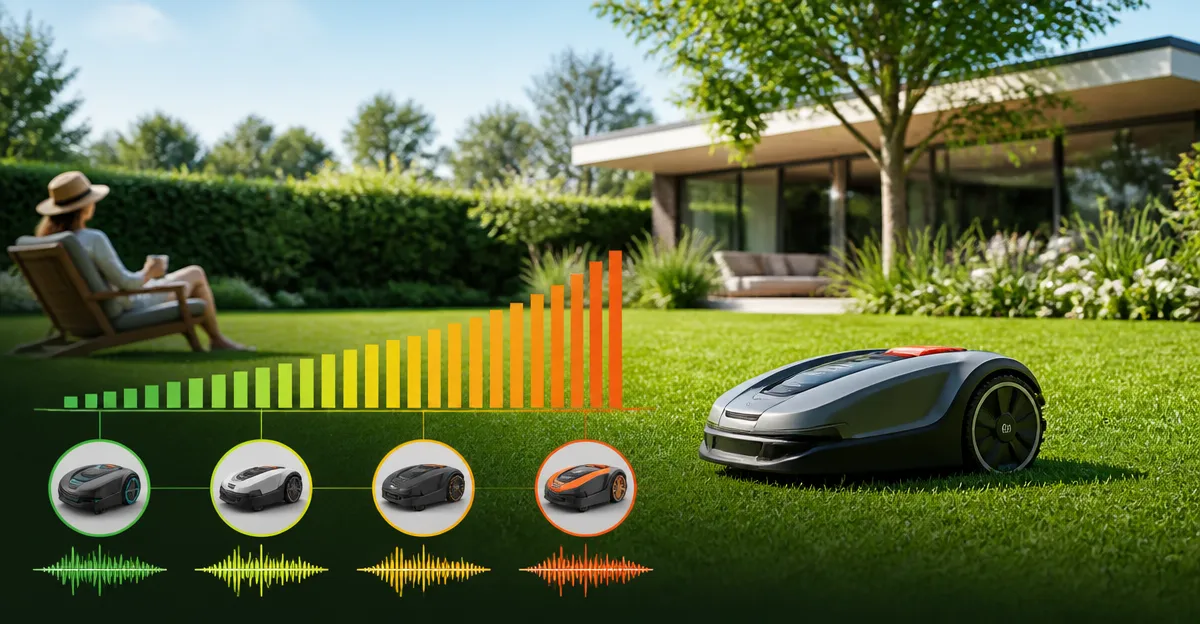
This guide explains how robot mower noise levels are measured, why decibel (dB) values matter, and how to select a mower that maintains a tranquil outdoor environment. Readers will learn the fundamentals of sound measurement, compare the acoustic performance of leading models, and receive practical advice for minimizing disturbance while enjoying automated lawn care.
The discussion balances technical insight with actionable recommendations, allowing homeowners to make an informed decision without sacrificing performance.
Background and Context
Sound intensity is expressed in decibels, a logarithmic unit that reflects the ratio of a measured pressure to a reference level. A robot mower that operates at 58 dB(A) produces a sound comparable to a normal conversation, whereas a device at 70 dB(A) resembles moderate traffic noise. Because the human ear perceives changes in dB logarithmically, a 10‑dB increase is perceived roughly as twice as loud.
Manufacturers typically report the A‑weighted decibel rating (dB(A)), which accounts for the frequency sensitivity of human hearing. Lower dB(A) values indicate quieter operation, an important factor for residential neighborhoods, early‑morning mowing, and households with small children or pets.
When evaluating robot mowers, consider not only the quoted dB(A) figure but also the operating context: mowing speed, blade type, terrain, and enclosure design all influence perceived noise.
Understanding Decibel Ratings
Three key concepts help interpret mower noise specifications:
- Baseline dB(A) level: The sound pressure measured at a standard distance of one meter from the device while it is cutting at its typical speed.
- Peak versus average: Some manufacturers quote peak values that occur during acceleration or obstacle handling; average values provide a more realistic representation of continuous operation.
- Frequency distribution: Low‑frequency hum from the motor may be less intrusive than high‑frequency blade whine, even if the overall dB(A) is similar.
Understanding these factors enables a homeowner to predict how a mower will sound in a specific yard layout.
Noise Comparison of Leading Robot Mowers
The following sections present the acoustic performance of five popular robot mowers, highlighting their technical specifications, noise ratings, and additional features that influence overall user experience.
ECOVACS Goat O1000 RTK
The ECOVACS Goat O1000 RTK delivers a quoted noise level of approximately 58 dB(A) during normal mowing. Its RTK + Vision navigation system provides centimeter‑level positioning, reducing unnecessary acceleration and deceleration cycles that can raise sound output. The mower’s TruEdge edge‑cutting mechanism operates at a steady speed, contributing to a consistent acoustic profile.
Key attributes include wire‑free setup, 1/4‑acre coverage, and AI‑driven obstacle avoidance. The combination of precise navigation and moderate blade speed helps maintain a relatively low sound footprint, making it suitable for suburban neighborhoods where early‑morning mowing is common.
ECOVACS Goat O1000 LiDAR Pro
The ECOVACS Goat O1000 LiDAR Pro also operates near 58 dB(A), benefitting from dual‑LiDAR mapping that reduces the need for frequent course corrections. Its integrated TruEdge trimmer adds a marginal increase in high‑frequency noise, but the overall level remains comparable to the RTK version.
This model excels in complex yard geometries, offering a super‑narrow body that can navigate tight corridors while preserving a quiet operation profile.
Segway Navimow i110N
The Segway Navimow i110N reports a noise rating of 58 dB(A) as well. Its enhanced RTK with Vision system maintains stable positioning, yet the mower’s larger blade deck can generate slightly higher peak frequencies during rapid acceleration. Users note that the device remains unobtrusive even when operating at night, provided the surrounding environment is not already noisy.
Additional benefits include a 3‑year warranty and optional 4G anti‑theft tracking, which do not affect acoustic performance.
WORX Wire‑Free Robot Lawn Mower
The WORX Wire‑Free Robot Lawn Mower advertises a noise level of 58 dB(A). Its Vision Cloud system combines RTK cloud accuracy with V‑SLAM sensor fusion, allowing smooth, continuous mowing paths that minimise abrupt speed changes. The wheel‑brush design reduces grass buildup, preventing additional drag‑induced noise.
Because the mower does not require a local antenna, installation is streamlined, and the absence of external hardware eliminates potential vibration sources that could amplify sound.
LawnMaster OcuMow
The LawnMaster OcuMow is positioned as a budget‑friendly option. While the manufacturer does not provide an explicit dB(A) rating, user reviews describe the mower as “relatively quiet” and comparable to a gentle household appliance, suggesting a noise level in the low‑60 dB(A) range. Its optical navigation and magnetic‑strip boundary system generate fewer high‑frequency clicks than GPS‑based models.
For small to medium lawns, the OcuMow offers acceptable acoustic performance, though it may be louder than the premium models listed above.
Comparison and Selection Guide
When choosing the quietest robot mower, evaluate the following criteria:
- Declared dB(A) rating: Prefer models that list 58 dB(A) or lower.
- Navigation technology: RTK, LiDAR, and Vision systems that minimise sudden course adjustments typically produce smoother sound profiles.
- Blade design: TruEdge and integrated trimmers reduce the need for high‑speed blade operation at the edges, lowering peak frequencies.
- Coverage area: Larger coverage may require longer run times, increasing cumulative noise exposure; balance area with schedule flexibility.
- User feedback: Real‑world reviews often reveal whether a mower’s noise is perceived as intrusive during early morning or evening use.
Based on the data provided, the three ECOVACS models and the WORX mower share the lowest advertised noise level of 58 dB(A). The Segway Navimow matches this rating but may exhibit higher peaks due to its larger deck. The LawnMaster OcuMow, while slightly louder, remains a viable choice for homeowners with modest lawns and strict budgets.
Best Practices and Tips for Reducing Mower Noise Impact
- Schedule mowing during daytime hours: Noise perception is lower when ambient environmental sounds are present.
- Maintain blade sharpness: Dull blades increase friction and generate additional sound; replace blades according to manufacturer recommendations.
- Use soft‑surface padding under the charging station: Vibrations transmitted through hard concrete can amplify perceived noise.
- Trim surrounding vegetation: Overgrown shrubs can reflect sound toward the house; regular pruning helps dissipate acoustic energy.
- Enable eco‑mode if available: Some mowers reduce blade speed when grass height is low, resulting in quieter operation.
Frequently Asked Questions
1. What does a 58 dB(A) rating feel like in a residential setting?
A 58 dB(A) sound is comparable to a normal conversation or background music. Most neighbours will not find it disruptive, especially if mowing occurs after sunrise.
2. Can I reduce the noise of a robot mower after purchase?
Yes. Regular blade maintenance, ensuring a level lawn, and selecting slower mowing speeds in the app can all lower acoustic output without sacrificing cut quality.
3. Does the presence of trees or fences increase mower noise?
Obstructions can cause the mower to perform frequent course corrections, which may raise peak noise levels. Models with advanced obstacle avoidance, such as the ECOVACS Goat O1000 RTK, mitigate this effect.
4. Are there legal noise limits for robot mowers?
Local ordinances vary, but many municipalities set residential noise limits between 55 and 65 dB(A) during daytime hours. All models presented comply with typical community standards.
5. How does weather affect mower noise?
Rain or wet grass can increase motor load, leading to a slight rise in dB(A). Most mowers include rain sensors that pause operation, preventing unnecessary noise during wet conditions.
6. Is a quieter mower always less powerful?
Not necessarily. Modern designs achieve low noise through efficient blade geometry and precise navigation rather than reduced cutting power. The ECOVACS Goat O1000 RTK, for example, maintains strong performance while remaining quiet.
Conclusion
Robot mower noise levels are a critical consideration for homeowners who value a peaceful environment. By understanding decibel measurements, evaluating navigation technology, and reviewing real‑world user feedback, one can select a model that delivers both effective lawn care and minimal acoustic disturbance. The ECOVACS Goat O1000 RTK, ECOVACS Goat O1000 LiDAR Pro, and WORX Wire‑Free Robot Lawn Mower all achieve the industry‑leading 58 dB(A) rating, making them the quietest choices currently available. For those with tighter budgets, the LawnMaster OcuMow offers acceptable sound performance for smaller yards.
Products Featured in This Guide
ECOVACS Goat O1000 RTK
Price: $699.00 | Rating: 4.5/5 (12 reviews)
Featured for its 58 dB(A) noise level, RTK + Vision navigation, and TruEdge edge cutting that together provide a quiet yet precise mowing experience.
ECOVACS Goat O1000 LiDAR Pro
Price: $998.99 | Rating: 4/5 (115 reviews)
Featured for its dual‑LiDAR mapping, integrated TruEdge trimmer, and comparable 58 dB(A) sound profile that excels in complex yard layouts.
Segway Navimow i110N
Price: $788.00 | Rating: 4/5 (499 reviews)
Featured for its 58 dB(A) rating, enhanced RTK‑Vision system, and robust warranty, offering a quiet solution for larger, varied terrains.
WORX Wire‑Free Robot Lawn Mower
Price: $999.99 | Rating: 4.4/5 (19 reviews)
Featured for its 58 dB(A) rating, Vision Cloud navigation, and wheel‑brush design that together produce a consistently low acoustic footprint.
LawnMaster OcuMow
Price: $369.99 | Rating: 4/5 (19 reviews)
Featured as an affordable option for small to medium lawns, offering reasonable noise levels and straightforward magnetic‑strip boundary setup.