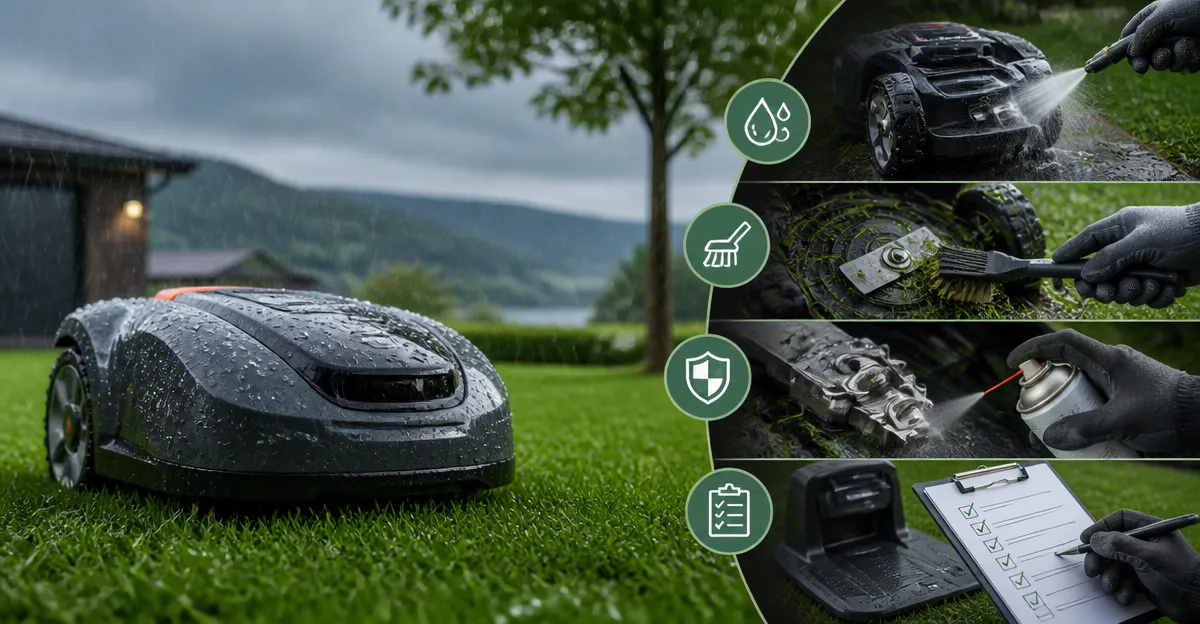
How to Maintain Your Robot Lawn Mower in Wet Climates: Essential Rainy-Weather Care, Rust Prevention & Seasonal Checklist
Introduction
Homeowners who rely on robotic lawn mowers often face the challenge of keeping their devices functional during prolonged rain and high humidity. This guide explains how to protect electronic components, prevent rust on moving parts, and perform a comprehensive seasonal checklist. By following these procedures, readers will extend the lifespan of their mower, maintain cutting performance, and avoid costly repairs.
The information presented applies to a wide range of models, from entry‑level units to premium all‑terrain machines. Whether one owns a compact YARDCARE V100 Robot Lawn Mower or a high‑end Mammotion LUBA 3 AWD Robot Mower, the principles remain the same. The guide is organized into clear steps, each accompanied by product recommendations that simplify the process.
Readers will learn how to clean after rain, apply rust‑inhibiting treatments, verify navigation systems, and schedule preventive maintenance. The result is a mower that operates reliably year after year, even in the most demanding climates.
What You'll Need
- Soft microfiber cloths for drying
- Isopropyl‑based electronics cleaner
- Rust‑prevention spray (e.g., a silicone‑based protectant)
- Replacement blades – the extra blades included with the ECOVACS Goat O1000 RTK Care Kit are ideal for most models
- RTK extension cable (provided with the ECOVACS kit) for improved satellite signal in dense foliage
- Smartphone with the mower’s dedicated app
Step 1: Inspect and Clean the Mower After Rain
The first action after any heavy rain is a visual inspection. Look for standing water in the charging dock, on the wheels, and around the blade housing. Water trapped in these areas can cause short‑circuiting and accelerate corrosion. Use a dry microfiber cloth to gently blot excess moisture, then wipe the exterior with a lightly dampened cloth soaked in isopropyl cleaner. This removes mineral deposits that could later become rust.
If the mower is equipped with an RTK antenna, such as the one included in the ECOVACS Goat O1000 RTK Care Kit, ensure the antenna is free of droplets. The kit’s RTK extension cable allows the antenna to be positioned higher, reducing exposure to splash from low‑lying grass. This step protects the precision navigation system, which is essential for centimeter‑level accuracy.
For models with visual navigation, like the YARDCARE V100 Robot Lawn Mower, clean the camera lens with a soft lens tissue. A clear lens ensures the AI vision can differentiate grass from obstacles, even after rain.
After cleaning, allow the mower to air‑dry in a shaded, well‑ventilated area for at least 30 minutes before proceeding to the next step.
Step 2: Apply Rust‑Prevention Treatment
Moisture combined with salt or mineral deposits creates an ideal environment for rust on metal components. Apply a thin coat of silicone‑based rust‑prevention spray to the blade housing, wheel axles, and any exposed fasteners. The spray forms a breathable barrier that repels water while allowing heat dissipation, preventing corrosion without interfering with moving parts.
The extra blades supplied with the ECOVACS Goat O1000 RTK Care Kit are manufactured from hardened steel and come pre‑coated with a rust‑inhibiting finish. Replacing dull or rust‑prone blades with these spares reduces the need for frequent spray applications and maintains a consistently sharp cut.
For heavy‑duty models such as the Mammotion LUBA 3 AWD Robot Mower, focus on the AWD motor housings and the LiDAR sensor housing. These areas are more exposed to splashing water when navigating steep slopes. A light mist of the spray protects the high‑torque motors without adding excess weight.
Allow the protective coating to cure for 10‑15 minutes before moving the mower back to its charging station.
Step 3: Maintain the Blade System
Sharp blades cut grass cleanly, reducing the amount of moisture retained in the clippings. Overly long or dull blades cause tearing, which can lead to fungal growth on the lawn. Inspect the blades for nicks, rust spots, or loss of sharpness. If any defect is observed, replace the blade set using the spare blades from the ECOVACS Goat O1000 RTK Care Kit. Each kit includes 36 replacement blades, providing enough spares for multiple replacements per year.
When installing new blades, ensure the locking screw is tightened to the manufacturer’s torque specification. This prevents vibration that could loosen the blade during wet operation, a common cause of premature wear.
For the YARDCARE V100 Robot Lawn Mower, the cutting width is 6.3 inches; a single blade set is sufficient for a 1,600 sq ft area. However, the V100’s magnetic strip can be repositioned to create a “no‑go” zone around wet patches, protecting the blade from excessive moisture.
After blade replacement, manually rotate the blade assembly to verify smooth movement before re‑engaging the mower.
Step 4: Verify Electronics and Connections
Water intrusion is the most common cause of electronic failure in wet climates. Examine all connectors, especially the charging contacts and the RTK antenna cable. Use a dry cotton swab to remove any corrosion, then apply a small amount of contact cleaner. The RTK extension cable included with the ECOVACS Goat O1000 RTK Care Kit is designed with sealed connectors that resist moisture, making it a reliable choice for humid environments.
For the Segway Navimow X430 Robot Lawn Mower, the EFLS tri‑frequency Network RTK system relies on a stable satellite link. After cleaning, check the signal strength in the app; a strong signal indicates that the antenna and cable are properly sealed.
If the mower uses a Wi‑Fi hotspot for connectivity, ensure the hotspot is placed in a sheltered location to avoid rain exposure. A waterproof enclosure can be fabricated from a simple PVC pipe, but this is optional for most users.
Finally, power on the mower and observe the diagnostic screen for any error codes related to moisture or low battery voltage.
Step 5: Update Software and Navigation Settings
Manufacturers regularly release firmware updates that improve water‑resistance algorithms and refine obstacle‑avoidance logic. Open the mower’s dedicated app and check for the latest version. For the YARDCARE V100 Robot Lawn Mower, the app includes a “Rain Sensor Calibration” tool that adjusts the mower’s behavior when humidity exceeds a preset threshold.
For RTK‑enabled models such as the ECOVACS Goat O1000 RTK Care Kit, enable “Adaptive Mapping” to allow the mower to re‑map areas that become temporarily water‑logged. This prevents the mower from repeatedly attempting to cut through soggy patches, reducing motor strain.
High‑end models like the Mammotion LUBA 3 AWD Robot Mower offer multiple path‑planning modes (zigzag, checkerboard, adaptive zigzag). Selecting “adaptive zigzag” in wet conditions optimizes coverage while minimizing wheel slippage on muddy terrain.
After updating, run a short test cycle on a dry section of the lawn to confirm that the mower responds correctly to the new settings.
Step 6: Seasonal Checklist for Wet Climates
Perform the following checklist at the start of each rainy season and again after a prolonged dry spell:
- Inspect the charging dock for water pooling; elevate the dock if necessary.
- Clean the blade housing, wheels, and RTK antenna with isopropyl cleaner.
- Apply rust‑prevention spray to all metal surfaces.
- Replace blades using the spare set from the ECOVACS Goat O1000 RTK Care Kit if wear is evident.
- Check the battery health in the app; calibrate the battery if the charge‑discharge cycle deviates from the norm.
- Verify firmware is up to date and enable rain‑sensor or adaptive mapping features.
- Test the mower on a small perimeter to ensure navigation accuracy before resuming full‑yard operation.
Completing this checklist reduces the likelihood of unexpected shutdowns, preserves blade sharpness, and maintains accurate positioning throughout the wet months.
Tips & Pro Tips
- Schedule mowing sessions early in the morning when dew has evaporated but the ground is still dry.
- Use a breathable cover for the charging station if your yard is prone to standing water.
- For steep slopes, the Mammotion LUBA 3 AWD Robot Mower offers superior traction; its AWD system reduces slippage on wet terrain.
- When using the ECOVACS Goat O1000 LiDAR Pro, enable the built‑in edge‑trimming feature to avoid manual touch‑ups on wet borders where grass tends to cling to stones.
- Store the mower in a dry garage during prolonged periods of rain to protect the battery from temperature extremes.
Troubleshooting
Problem: Mower stops mid‑cycle and returns to base prematurely.
Solution: Check the rain sensor status in the app; a false positive can be reset by cleaning the sensor window and recalibrating.
Problem: Navigation errors or missed zones after heavy rain.
Solution: Re‑run the auto‑mapping routine. For RTK models, verify the RTK extension cable is firmly connected and the antenna has a clear sky view.
Problem: Blade motor stalls in soggy grass.
Solution: Reduce the cutting height by 0.5 inches and enable the “low‑power” mode if available. This reduces torque load on wet vegetation.
Conclusion
Maintaining a robot lawn mower in wet climates requires diligent cleaning, rust prevention, blade care, and software management. By following the step‑by‑step instructions and applying the seasonal checklist, homeowners can ensure reliable operation throughout rainy periods. The recommended products—particularly the ECOVACS Goat O1000 RTK Care Kit for extra blades and RTK stability, and the robust Mammotion LUBA 3 AWD Robot Mower for steep, wet terrain—provide targeted solutions that simplify each maintenance task. Consistent care not only protects the investment but also delivers a consistently manicured lawn with minimal effort.
Products Mentioned in This Guide
Frequently Asked Questions
How often should I clean my robot lawn mower after it’s been out in the rain?
Rinse and dry the mower within 24 hours, then inspect the wheels, sensors, and deck for trapped moisture.
What is the most effective way to prevent rust on a robot mower’s blades and chassis in wet climates?
Apply a silicone‑based rust inhibitor or protective spray after cleaning, and store the mower in a dry, sheltered location.
Is it safe to run a robot lawn mower during light rain?
Yes—most models are IPX4 rated and can mow in light rain, but avoid heavy downpours that could flood the electronics.
What seasonal checklist items are essential before winter in a rainy region?
Clean the deck, lubricate moving parts, check battery health, ensure drainage holes are clear, and store the mower under cover.
How can I protect the mower’s electronic components from high humidity?
Keep the charging station covered, place desiccant packs inside the mower housing, and verify that all seals are intact.