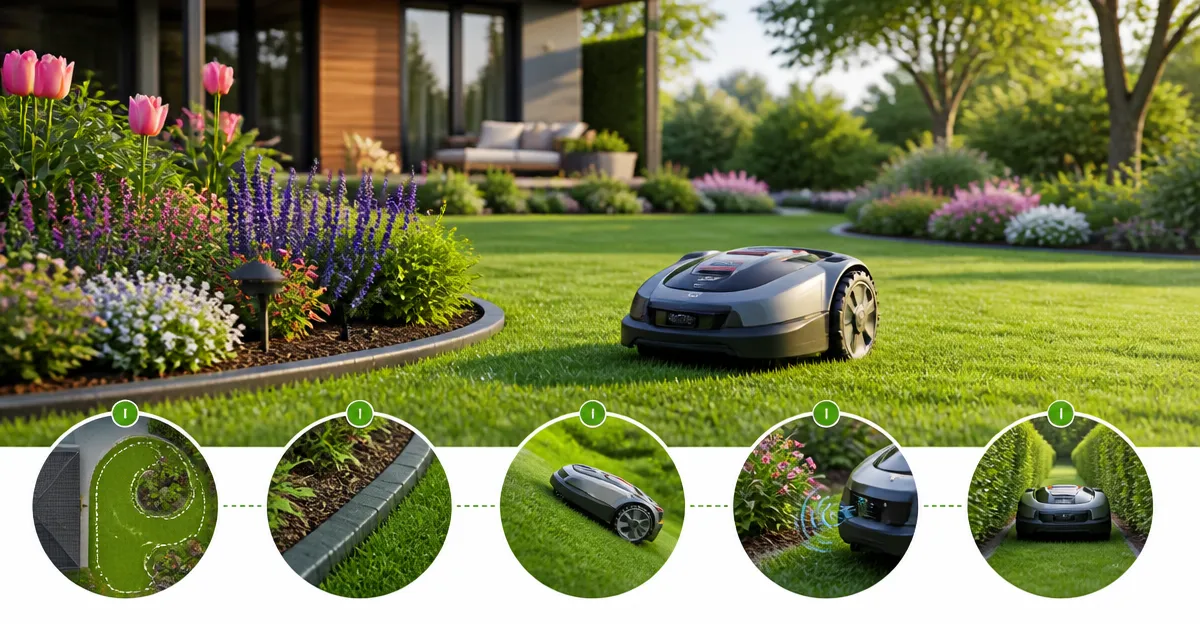
How to Choose the Best Robot Mower for Landscaped Yards with Flower Beds — Protect Plants, Preserve Edges & Navigate Obstacles
This guide explains how a homeowner can evaluate and select a robotic lawn mower that respects delicate flower beds, maintains clean edges, and reliably avoids obstacles. The reader will learn how to assess yard characteristics, compare navigation technologies, configure virtual boundaries, and schedule maintenance. By following the steps, one can achieve a well‑mowed lawn without damaging ornamental plants.
What You Will Need
- Measuring tape or laser distance meter
- Smartphone with internet access
- Wi‑Fi network covering the mowing area
- Optional: One of the recommended robot mowers
Step 1: Assess Yard Layout and Identify Sensitive Areas
Begin by walking the entire property and noting the location of flower beds, ornamental shrubs, and hard‑scaping features such as pathways and retaining walls. Measure the total square footage of the lawn and record the steepest slope. This information will determine the required climbing ability and coverage capacity of the mower. For example, a slope of 35 percent may require a mower with enhanced traction and an adaptive suspension system.
Document the dimensions of each flower bed and the distance between beds and the main lawn. This data will be used later when creating no‑go zones in the mower’s app. It is advisable to sketch a simple diagram or use a digital mapping tool to visualize the layout.
When the yard includes multiple zones with different grass types, consider a mower that supports separate mowing zones and custom height settings. This ensures that fine‑leaf grasses receive a different cut height than coarser varieties.
At this stage, no product recommendation is required; the focus is on gathering accurate measurements.
Step 2: Map Boundaries and Create Virtual Perimeters
Modern robot mowers rely on virtual boundaries rather than physical perimeter wires. Using the companion app, one can trace the lawn perimeter and define exclusion zones around flower beds. The Goat A3000 LiDAR Pro excels at wire‑free mapping thanks to its dual‑LiDAR system, which produces a precise 2 cm positioning map even under tree canopies.
Key features that support this step include:
- Dual‑LiDAR navigation for accurate boundary detection
- Edge‑to‑edge cutting with built‑in TruEdge trimmer, reducing the need for manual trimming around beds
- Smart app controls that allow the user to draw no‑go polygons directly on the map
The Goat A3000 is priced at $1,799.00 and holds a 3.7‑star rating from 103 reviews. Its ability to map complex layouts without a perimeter wire makes it a strong candidate for yards with numerous flower beds.
After completing the initial map, verify that the virtual fence follows the true edge of the lawn and that all flower beds are correctly excluded. Adjust the map as needed before proceeding to the next step.
Step 3: Choose Navigation Technology That Matches Terrain Complexity
Two primary navigation technologies dominate the market: LiDAR‑based systems and RTK (Real‑Time Kinematic) satellite positioning. LiDAR provides reliable indoor‑like accuracy and excels in shaded areas, while RTK delivers centimeter‑level precision in open sky conditions.
For yards with steep slopes and uneven terrain, the Mammotion LUBA 3 AWD 3000H combines 360° LiDAR, NetRTK, and dual‑camera AI vision. Its four independent motors enable climbing slopes up to 80 percent (38.6°) and stepping over obstacles up to 50 mm high. The mower is priced at $2,448.00 and carries a 4.3‑star rating from 31 reviews, indicating strong performance on challenging terrain.
If the property is smaller (up to 1/4 acre) and the owner prefers a more affordable solution, the Goat O1000 RTK provides precise RTK + Vision navigation at a price of $699.00 with a 4.5‑star rating from 12 reviews. Its AIVI 3D obstacle avoidance is sufficient for most residential lawns.
Select the mower whose navigation system aligns with the yard’s exposure to sky and the presence of obstacles. LiDAR‑only units are preferable for heavily treed areas, whereas RTK units excel on open, flat lawns.
Step 4: Prioritize Edge Trimming for Flower Bed Preservation
Flower beds often require a crisp border to prevent grass encroachment. A mower equipped with an integrated edge trimmer can maintain these borders without manual string trimming. Both the Goat A3000 LiDAR Pro and the Goat O1000 LiDAR Pro feature TruEdge technology.
The Goat O1000 LiDAR Pro is priced at $998.99 and holds a 4‑star rating from 188 reviews. Its super‑narrow body (0.8 m width) allows it to navigate tight corridors between beds and pathways, ensuring a clean cut along the edge of every flower bed.
When configuring the mower, set the edge‑trimming aggressiveness to a moderate level. This prevents the blades from striking delicate plants while still delivering a tidy border. Test the setting on a small section of the lawn before applying it to the entire perimeter.
For larger properties where edge trimming is less critical, the Mammotion LUBA 3 AWD’s adaptive suspension can still provide clean edges through precise path planning, though it does not include a dedicated trimmer.
Step 5: Configure Obstacle Avoidance to Protect Plants and Garden Items
Robotic mowers rely on sensors to detect obstacles such as garden statues, pet toys, and low‑lying branches. The Mammotion LUBA 3 AWD 3000H identifies more than 300 obstacle types using AI vision and LiDAR, providing a high level of safety for delicate flora.
Alternatively, the Goat O1000 RTK employs AIVI 3D obstacle avoidance, which detects objects as small as 5 cm and can navigate passages as narrow as 2.3 ft. Its obstacle detection is especially useful in gardens with frequent rearrangements.
During setup, mark any permanent garden features as “no‑go” zones within the app. This instructs the mower to steer clear of flower beds, raised planters, and irrigation heads. For temporary items such as toys, rely on the mower’s real‑time detection capabilities.
Regularly clean the sensor lenses and LiDAR windows to maintain detection accuracy. Dust or debris can reduce the effectiveness of obstacle avoidance algorithms.
Step 6: Set Up Scheduling, Cutting Height, and Maintenance Routines
After the mower has been mapped and its safety zones defined, program a mowing schedule that aligns with the growth rate of the grass. Most homeowners find a 2‑ to 3‑day interval sufficient for warm‑season grasses, while cooler climates may require weekly mowing.
Adjust the cutting height according to the type of grass and the desired aesthetic. The Mammotion LUBA 3 AWD offers automatic height adjustment based on grass density, whereas the Goat series allows manual height selection via the app.
Plan regular maintenance: inspect blades after every 30‑hour runtime, clean the charging contacts, and verify battery health. The Goat O1000 RTK provides battery‑life notifications within its app, simplifying upkeep.
Finally, enable rain‑delay features if the mower supports them. This prevents operation on wet soil, which can lead to uneven cuts and potential damage to delicate plant roots.
Tips & Pro Tips
- When mapping large properties, divide the area into multiple zones to reduce memory load and improve navigation speed.
- Place the RTK antenna or LiDAR base station on an elevated pole or fence post to maximize sky visibility.
- For flower beds with irregular shapes, use the app’s polygon tool to create custom no‑go zones that hug the bed’s contour.
- Schedule a brief “test run” after each software update to confirm that mapping and edge‑trimming settings remain accurate.
- Consider adding a small, weather‑proof camera to the charging station for remote monitoring of the mower’s status.
Troubleshooting
Problem: The mower repeatedly stops near a flower bed.
Solution: Verify that the edge‑trimming aggressiveness is not set too high. Reduce the setting and observe whether the mower resumes normal operation. Additionally, check for debris on the LiDAR sensor that could cause false obstacle detection.
Problem: The mower loses Wi‑Fi connectivity in a distant zone.
Solution: Install a Wi‑Fi extender or use the optional 4G module (available for the Segway Navimow i110N) to maintain a stable connection throughout the property.
Problem: Battery does not reach the advertised runtime.
Solution: Ensure the charging contacts are clean and that the battery temperature is within the recommended operating range. For cold climates, allow the battery to warm up before the first mow of the day.
Conclusion
Choosing the optimal robot mower for a landscaped yard with flower beds requires careful evaluation of terrain, navigation technology, edge‑trimming capability, and obstacle avoidance. By assessing the yard, mapping virtual boundaries, selecting a navigation system that matches the environment, and configuring edge and safety settings, one can achieve a pristine lawn while protecting ornamental plants. The recommended models—Mammotion LUBA 3 AWD 3000H, ECOVACS Goat A3000 LiDAR Pro, ECOVACS Goat O1000 RTK, Segway Navimow i110N, and ECOVACS Goat O1000 LiDAR Pro—provide a range of solutions for various budget and property sizes.
Products Mentioned in This Guide
Frequently Asked Questions
What features should I look for in a robot mower to protect flower beds?
Choose a mower with precise edge‑cutting, adjustable virtual boundaries, and obstacle‑avoidance sensors to keep blades away from delicate plants.
How does slope affect the choice of a robot mower?
Mowers with higher climbing ability (typically 30‑45% grade) are needed for steep lawns to ensure consistent cutting without slipping.
Can I set up virtual boundaries without physical wires?
Yes, many modern models use GPS or magnetic boundary strips that let you define no‑mow zones around flower beds via a smartphone app.
What Wi‑Fi requirements are necessary for reliable robot mower operation?
A stable 2.4 GHz network covering the entire mowing area ensures the mower can receive updates, schedules, and boundary changes without interruption.
How often should I maintain a robot mower used around ornamental plants?
Clean the blades and sensors after each use, check the cutting deck for debris weekly, and perform a full service (battery check, blade sharpening) every 3‑4 months.